 |
| The pollen sack is clearly visible on this photograph- the grey bulge on the leg |
school garden

Monday, 20 June 2011
Busy as a bee!
This morning when the temperature was much warmer than in recent days there were a lot of bees foraging in the school garden. On Mr Galloway's class patch of red poppies there were many bumble bees and honey bees all busy collecting pollen. In the photograph below you can see the pollen sack on the bumble bee absolutely bursting with pollen collected during its' visit to the school garden.

Sunday, 19 June 2011
Going Batty!
Last evening we put up two bat boxes on the large Sycamore tree in the school garden. We are hoping that some of the bats which have been seen flying around the garden in the evenings will spot them and move in. The school has been kindly loaned a bat detector by the local RSPB team so on the next warm evening we will pop up to the garden at dusk and try to identify the bats as they fly about hoovering up the moths.
The RSPB Reserve Manager has offered to give us a bat talk so we might take up his kind offer soon
In the greenhouse this morning our gourd plants were in flower.The plants are now growing very fast -several inches every day- and they are creeping across the net in the roof of the greenhouse.
And finally for today. Those pigeons are back. They have moved on from the peas and now they have found the cabbage plants. For some reason they have not yet found the brussel sprout plants. Let us hope it stays that way!
The RSPB Reserve Manager has offered to give us a bat talk so we might take up his kind offer soon
 | ||
| The Bat Detector |
 |
| The Bat Boxes |
In the greenhouse this morning our gourd plants were in flower.The plants are now growing very fast -several inches every day- and they are creeping across the net in the roof of the greenhouse.
 |
| The gourd in flower |
 |
| The pigeon beak marks on one of the cabbage plants |
Saturday, 18 June 2011
An Angel Arrived
Sometime over the last couple of days an Angel has arrived in the garden. I have no idea who brought her but she is sitting under a tree in the memory corner, reading a book. A most apt place for her and I hope she likes it there and decides to stay.
 |
| An Angel |
Sunday, 12 June 2011
The Rose Chafer
Recently Pete and I were buzzed by a quite large exotic looking irridescent green 'thing' which whizzed around our heads several times and then crash landed into one of the garden beds. First impressions were something like a Egyptian Scarab beetle but we managed to catch the insect and put it into a small pot for identification. It was found to be a Rose Chafer. This is a very local species found only along the South coast of Britain , but widely across Europe. The larvae behave like earthworms creating compost from vegetable matter as they move around under the soil. All in all a useful species to have around.
 |
| Rose Chafer larvae |
 | ||||
| The Rose Chafer |
Sunday, 5 June 2011
Greenhouse Update
The last few warm days have seen temperatures in the greenhouse stay in the 30's even with the doors open. This has had an amazing effect on the plants inside. The papyrus was transplanted into three monster flower pots last week and it has doubled in size and is now throwing up flowering spikes. The gourds seem to grow in front of your eyes. They have now reached the roof of the greenhouse and will soon need to be trained along the supporting mesh, The rice plants have been re-potted this morning. Small cucumbers are forming and the tomatoes are just showing.
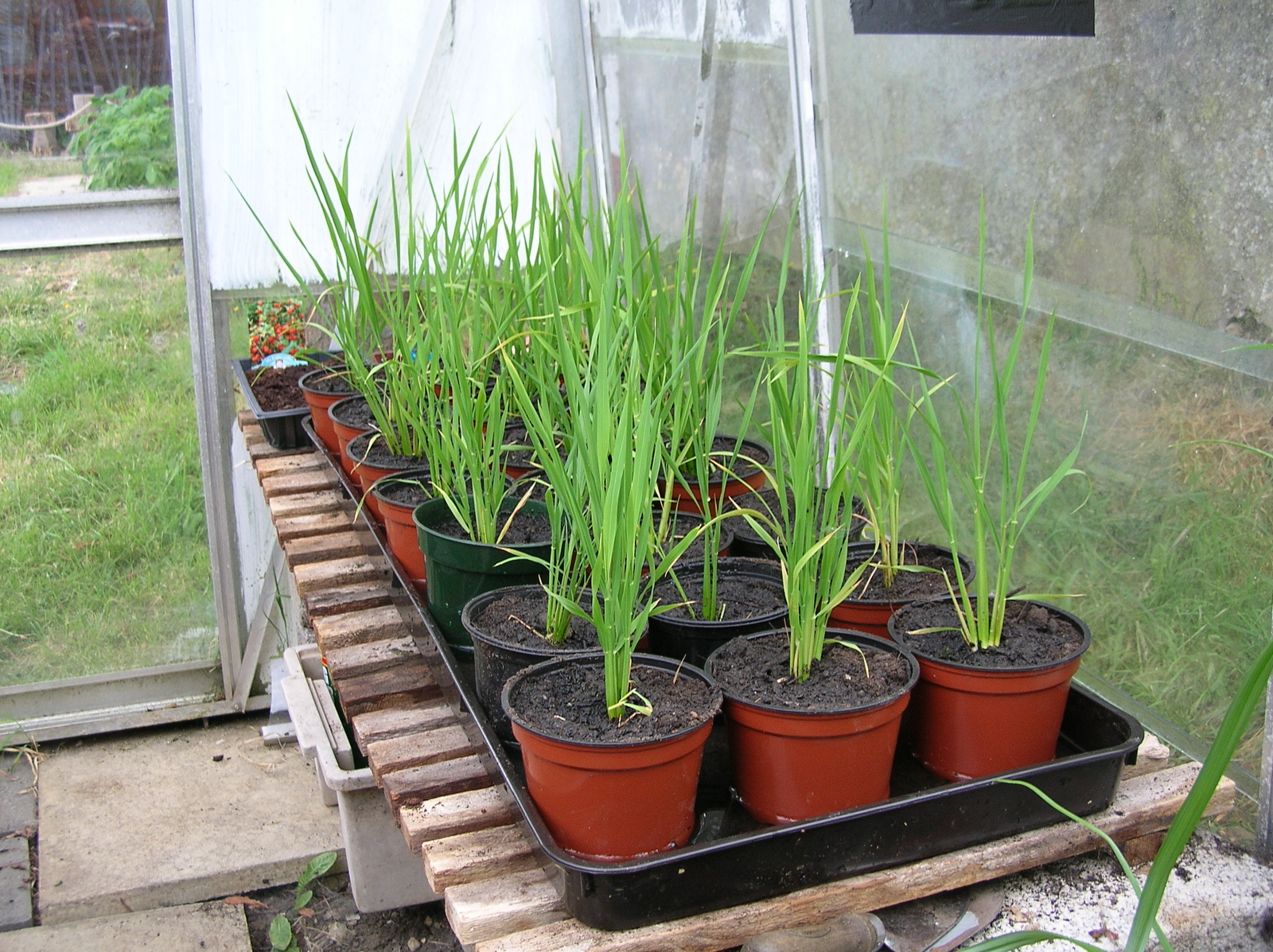 |
| The rice plants in their new pots |
 | ||
| The papyrus and the new flowering spikes The overnight rain has worked wonders on the sweetcorn plants and they are starting to fill out and reach upwards. The Gardening Club are trialing four different sorts of sweetcorn this year. They are growing the usual yellow cobbed variety, and also a purple cobbed variety which has links to the Hopi Indians in North America. The other two varieties on trial are the small cobs you see in the supermarkets in cling film (usually alongside a handful of mange tout) and actual popping corn.If the latter is successful we may be able to make our own popcorn up in the garden one afternoon later in the year.
|

Saturday, 4 June 2011
P is for pigeon - and peas
Whilst walking up the school path earlier 17 wood pigeons flew off from the classroom plots. On inspection it appeared that they had stripped the pea plants back to the stalks and taken a liking for the small beetroot plants by nipping off the leaves from the stem. Those naughty pigeons!
The willow classroom was covered with lots of immature ladybirds. They were munching on the large amounts of both greenfly and blackfly which have taken up refuge there. The picture below shows one creeping up on an unsuspecting greenfly. Hopefully these young ladybirds will find their way to the broad beans in the World War 2 garden where there are plenty of blackfly to feed on!
 |
| Wood Pigeon looking for more peas |
The willow classroom was covered with lots of immature ladybirds. They were munching on the large amounts of both greenfly and blackfly which have taken up refuge there. The picture below shows one creeping up on an unsuspecting greenfly. Hopefully these young ladybirds will find their way to the broad beans in the World War 2 garden where there are plenty of blackfly to feed on!
 |
| Immature ladybird creeping up on a greenfly (click to enlarge) |
Wednesday, 1 June 2011
Pond News
The warm weather during May has woken up life in the school pond. Two pairs of frogs laid lots of frogspawn earlier and the tadpoles are now growing fast with many having grown small legs ready to leave the pond very soon.
However the most exciting news is that we have discovered lots of breeding dragonflies and damselflies. The nymph stages of these were seen in early Spring either walking across the bottom of the pond liner or positioned on a plant stem, waiting for prey. These nymphs will eat just about anything which they find or swims by - even a small tadpole. They have large spring-loaded jaws!
 |
| young frog swimming across the pond |
However the most exciting news is that we have discovered lots of breeding dragonflies and damselflies. The nymph stages of these were seen in early Spring either walking across the bottom of the pond liner or positioned on a plant stem, waiting for prey. These nymphs will eat just about anything which they find or swims by - even a small tadpole. They have large spring-loaded jaws!
 | |||||
| Damselfly nymph Once the nymphs are ready to leave the pond they climb up a suitable plant stem which emerges from the water. This is often done in the early morning. Then the wonderful process of metamorphosis takes place - when a beautiful coloured insect emerges from the dull brown casing. As the insect emerges fluids are pumped into the wings to stretch them until they are perfectrly formed and then the same fluid is taken back into the body to extend the abdomen  The insects then bask in the sun for a while on the stem of the plant until they are ready to fly. The transformation is truely amazing.  |
 |
| Click to enlarge pictures of the dragonfly |
A recent pond dipping exercise found several very small newts and lots of Water Boatmen
which were very evident rushing up to the pond surface to collect a bubble of air and then diving back down to the bottom of the pond.
which were very evident rushing up to the pond surface to collect a bubble of air and then diving back down to the bottom of the pond.
 |
| A young Water Boatman- you can easily see the oars! |
Subscribe to:
Posts (Atom)